Understanding Recruitment Process Outsourcing
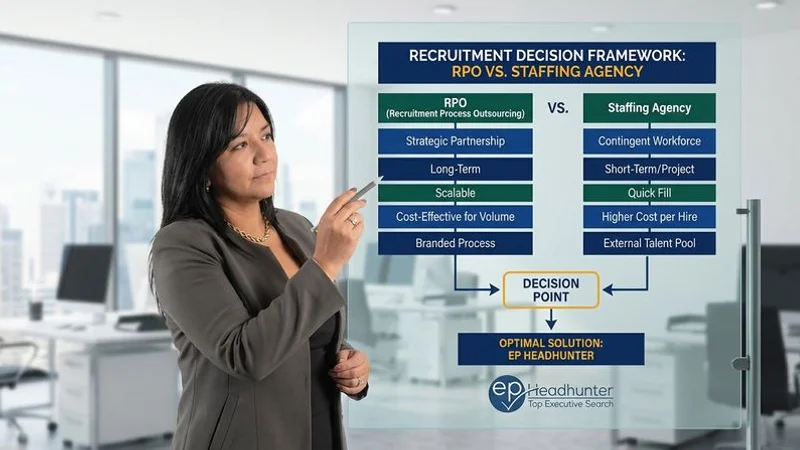
Recruitment Process Outsourcing (RPO) is a partnership model where an organization transfers all or part of its recruitment function to an external specialist. Unlike traditional staffing agencies (“temporales”) that fill individual seats on a transactional basis, an RPO partner embeds directly within your organization.
We see this distinction as critical for long-term success.
The partner assumes full ownership of the recruitment design and management, measured against strategic outcomes like retention and quality.
An RPO engagement is not just about offloading administrative work.
It fundamentally redesigns how you hire by implementing advanced workflows, technology platforms, and employer branding strategies.
For organizations in Colombia, this model offers a way to professionalize talent management quickly.
You gain immediate access to infrastructure that would otherwise take years to build internally.
But RPO is not the right fit for every company at every stage.
We suggest evaluating the following five indicators to see if an RPO engagement aligns with your current strategic needs.
Indicator 1: Your Hiring Volume Exceeds Internal Capacity
The most obvious sign is a persistent gap between the number of open roles and your team’s ability to close them.
Signs this indicator is present:
- Time-to-fill for tech roles exceeds 40 days. In 2025, the average time-to-fill for technology positions in Colombia hovers between 30 and 40 days. If your team consistently pushes past 60 days, you are losing money and productivity.
- Hiring managers are doing the sourcing. When line managers have to post on LinkedIn or screen CVs themselves, it pulls them away from their core revenue-generating responsibilities.
- Burnout is visible in your HR team. The recent implementation of Law 2101, reducing the Colombian workweek to 42 hours by 2026, has put additional pressure on internal teams to do more in less time.
- Seasonal spikes break your process. Fixed-size internal teams often struggle to scale up for a new plant opening or market expansion and then scale back down when volumes normalize.
Why RPO addresses this:
An RPO provider offers scalable recruitment capacity that flexes with your demand.
We deploy additional recruiters during your high-volume periods and reduce the team size when hiring subsides.
This elasticity prevents the fixed-cost burden of carrying a large internal recruitment team during quiet months.
In the Colombian context, this is vital for companies expanding into secondary cities where local sourcing networks may be thin.
Indicator 2: Your Cost Per Hire Is Unsustainably High
Many organizations underestimate their true cost per hire because they only count external spend.
We find that when you factor in internal salaries, job board subscriptions, and the “hidden” costs of vacancy, the numbers are often shocking.
Signs this indicator is present:
- Agency fees are eating your budget. Traditional agencies in Colombia typically charge 15-25% of the annual salary per hire. For a company hiring 50 people a year, this transactional model becomes prohibitively expensive.
- Sunday and night surcharges are increasing. With the labor reform (Law 2466) increasing Sunday surcharges to 100% by 2027, the operational cost of inefficient hiring teams working overtime is rising.
- The cost of bad hires is mounting. Recent data suggests a bad hire can cost a business upwards of 30% of that employee’s first-year earnings. For senior roles in Bogotá or Medellín, this can equate to tens of millions of pesos in wasted investment.
Why RPO addresses this:
RPO providers typically operate on a management fee or monthly model that consolidates costs.
This structure significantly reduces reliance on expensive contingency agencies.
Cost Comparison: Traditional Agency vs. RPO Model
| Feature | Traditional Agency | RPO Model |
|---|---|---|
| Cost Structure | 15-25% of annual salary per hire | Monthly management fee or fixed cost per hire |
| Scalability Costs | Linear (costs rise with every hire) | Economies of scale (cost per hire drops as volume rises) |
| Technology | Agency uses their own tools | RPO brings tech stack included in the fee |
| Ownership | Transactional (fill the seat) | Strategic (improve the process) |
Indicator 3: Your Recruitment Technology and Processes Are Outdated
Modern talent acquisition relies heavily on infrastructure that many mid-market Colombian companies have not yet adopted.
We know that competing for top talent in 2026 requires more than just a spreadsheet.
Signs this indicator is present:
- AI adoption is non-existent. With AI adoption in HR jumping from 26% to 43% across Latin America between 2024 and 2026, manual screening processes now put you at a severe speed disadvantage.
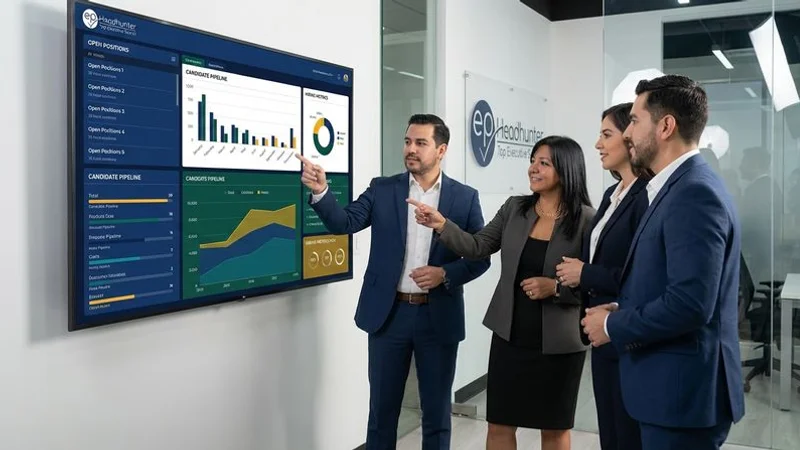
- Candidate tracking happens in Excel. Without a proper Applicant Tracking System (ATS), you cannot build talent pools for future use.
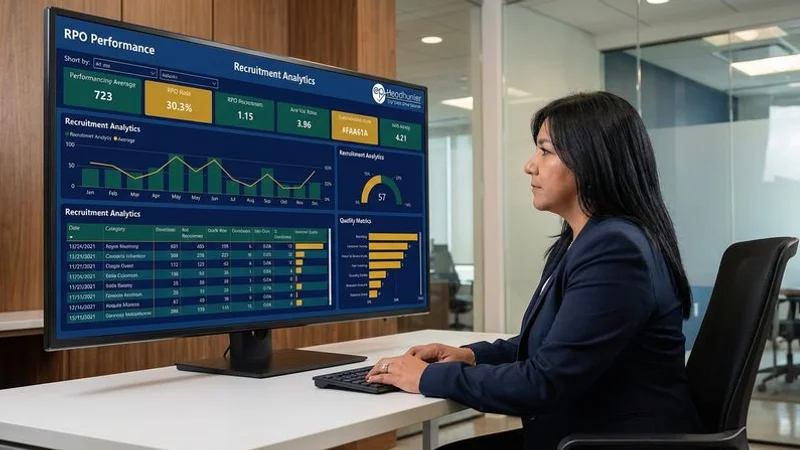
- You lack basic metrics. If you cannot instantly report on your “offer acceptance rate” or “source of hire,” you cannot optimize your budget.
- Sourcing is reactive. Posting a job on El Empleo and waiting is no longer sufficient to attract passive candidates who are not actively looking.
Why RPO addresses this:
RPO providers bring a pre-configured technology stack to the partnership.
This includes ATS platforms, CRM tools, and AI-driven assessment software that would be too costly for many companies to purchase independently.
You get immediate access to these tools without the long implementation times.
Indicator 4: Your Employer Brand Is Not Attracting the Right Talent
If top candidates are declining your offers, your market reputation may be the issue.
We often see this when a company’s “Employer Value Proposition” (EVP) fails to resonate with the modern workforce.
Signs this indicator is present:
- Offer decline rates exceed 25%. This is a clear signal that competitors are telling a better story or offering a better package.
- Candidates cite “culture” as a reason for rejection. In a market where indefinite term contracts are becoming the legal preference, candidates are prioritizing stability and clear cultural fit.
- You cannot attract talent from target competitors. If your sourcing team consistently fails to engage people from the companies you admire, your brand message is likely weak.
Why RPO addresses this:
A sophisticated RPO partner manages your employer brand at every touchpoint.
From the initial outreach message to the final offer letter, they ensure consistency and professionalism.
They also provide market intelligence on salaries and benefits, helping you stay competitive in hubs like Bogotá.

Indicator 5: You Are Entering New Markets or Undergoing Rapid Growth
Geographic expansion creates recruitment hurdles that standard teams are rarely equipped to handle.
We see this frequently with Colombian organizations expanding operations into neighboring regions or opening new tech hubs.
Signs this indicator is present:
- You are opening in a new city. Recruiting in Barranquilla requires a different approach and network than recruiting in Bogotá.
- Colombia has become your primary hub. With Colombia recently overtaking Argentina as the top hiring destination for many international companies, competition for local talent has intensified.
- Post-acquisition integration is messy. Merging two workforces requires specialized skills to manage redundancies and cultural alignment.
- You need to double your workforce quickly. Rapid scaling breaks traditional processes that rely on manual review.
Why RPO addresses this:
RPO providers have established networks and databases across multiple regions.
They can launch hiring campaigns in new markets immediately, navigating local compliance nuances and labor laws without delay.
This allows your core team to focus on business strategy rather than logistical hurdles.
Making the Decision: Key Evaluation Criteria
If these indicators sound familiar, it is time to evaluate potential partners.
We recommend using the following criteria to vet RPO providers:
- Regional Capability: Can they recruit effectively across all major Colombian cities and the wider LATAM region?
- Industry Expertise: Do they have a track record in your specific sector, whether it is BPO, tech, or manufacturing?
- Technology Stack: What specific ATS and AI tools do they bring, and how do they integrate with your current systems?
- Compliance Knowledge: Are they up to date with the latest changes in Colombian labor law, including the workweek reduction?
- Scalability: Can they demonstrate how they would handle a sudden 50% increase or decrease in hiring volume?
- Cultural Fit: Will their recruiters represent your brand authentically to candidates?
How EP HeadHunter’s RPO Solutions Work
EP HeadHunter offers tailored RPO solutions designed specifically for the Colombian and Latin American market.
We combine deep local market knowledge with advanced recruitment methodology to solve your most complex hiring challenges.
Our team embeds within your organization to deliver measurable improvements in quality, speed, and cost efficiency.
Whether you need end-to-end outsourcing or support for a specific project, we ensure your talent acquisition strategy is future-proof.
Recognize these indicators in your organization? Contact EP HeadHunter to explore how our RPO solutions can transform your talent acquisition capability.