The Cost of Not Having a Succession Plan
You know the scenario. A key leader hands in their resignation, or a sudden health issue forces an immediate departure. Strategic initiatives freeze instantly.
We see this panic set in frequently across Colombian enterprises. Teams lose their north star. Board members start making frantic phone calls. Competitors smell blood in the water and start poaching your clients.
Data paints a worrying picture for our local market. According to recent reports from the Superintendencia de Sociedades, nearly 70% of family-owned businesses in Colombia fail to transition successfully to the second generation. The primary culprit is rarely market conditions. It is almost always a lack of planned leadership continuity.
The financial hit of an unplanned exit is measurable and severe.
- Revenue Disruption: Active deals fall apart, and projects halt as management attention shifts to crisis control.
- The Talent Cascade: High-performing direct reports often leave with their leader. We find that companies can lose up to 15% of a department following a VP’s exit.
- Knowledge Drain: Years of institutional memory and handshake agreements walk out the door.
- Recruitment Premiums: Emergency executive searches in Bogotá or Medellín often cost 20% to 30% more than planned hires due to the urgency and lack of leverage.
Succession planning is not about predicting the future. It is about building a business that creates its own stability regardless of who sits in the chair.
A Five-Step Succession Planning Framework
We use a specific structure when advising clients that moves beyond vague “mentorship” ideas. This framework is practical and scalable for Colombian companies of all sizes.
Step 1: Identify Critical Roles
You cannot—and should not—build a plan for every single position. The first step is isolating the roles that would cause immediate operational failure if left vacant.
We recommend grading roles based on risk rather than just seniority.
| Factor | Questions to Ask |
|---|---|
| Revenue Control | Does this person control relationships that generate more than 10% of total revenue? |
| Technical Monopoly | Is this the only person who understands a proprietary system or process? |
| Strategic Impact | Does the role make decisions that affect the company’s 3-year horizon? |
| Team Stability | Would the departure trigger a mass exodus of other staff? |
| Regulatory Necessity | Is this role required by law (e.g., specific compliance officers)? |
Typical critical roles include:
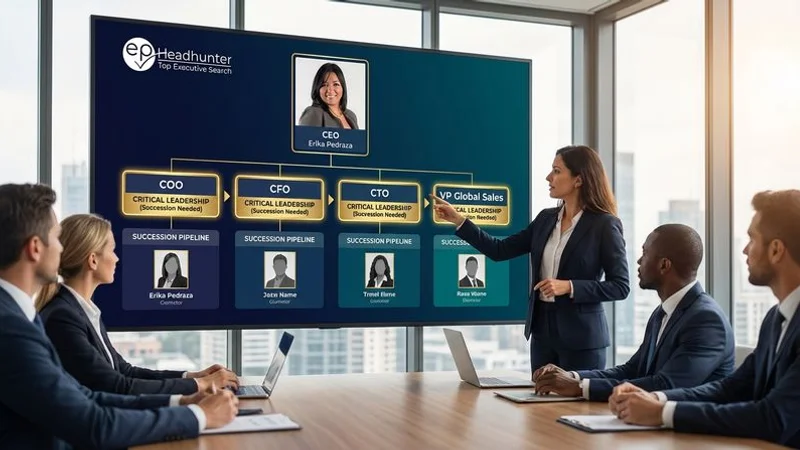
- C-Suite Leaders: CEO, CFO, COO, and increasingly the CTO.
- Revenue Heads: Commercial Directors or Country Managers.
- Technical Specialists: Chief Engineers or R&D Directors who hold patent knowledge.
- Bridge Roles: In family businesses, the non-family executive who translates between the family council and the operation.
Step 2: Assess Current Incumbents and Timeline
We need to look at the people currently in these seats with a cold, objective eye. You must assess how long they will realistically remain.
Assessment Dimensions:
- Retention Risk: Look at market demand. Headhunters are aggressively targeting bilingual executives in Colombia right now. Is your incumbent at risk of being poached?
- Performance Trajectory: A leader whose performance is plateauing requires a different timeline than one who is thriving.
- Retirement Horizon: Many founders and boomers are approaching retirement age. This date is often closer than boards realize.
Timeline Classification:
- Emergency (0-12 months): High risk of departure. You need an interim solution identified today.
- Transition (1-3 years): The standard window for grooming an internal successor.
- Strategic (3+ years): Low risk. Focus on long-term talent pipelining.
Step 3: Identify and Evaluate Potential Successors
We often see companies make the mistake of assuming the “Number 2” is the automatic successor. This is dangerous. The skills that make someone a great VP of Sales are often different from what makes a great CEO.
Internal Successor Evaluation Criteria:
- Strategic Thinking: Can they move from executing the plan to writing the plan?
- Cultural Fit: Do they embody the values you want the company to hold in five years?
- Emotional Intelligence: Can they manage the complex stakeholder maps often found in Latin American conglomerates?
- Agility: How do they handle rapid change or crisis?
Successor Readiness Matrix:
- Ready Now: Could start tomorrow morning with minimal disruption.
- Ready Soon (1-2 years): Needs one or two specific experiences to close the gap.
- Future Potential (3+ years): High talent, but needs significant grooming.
Step 4: Design Targeted Development Plans
A name on a list is not a plan. We insist that every potential successor has a specific roadmap to close their skill gaps.
Effective Development Accelerators:
- Stretch Assignments: Give them a “mini-CEO” experience. Have a potential successor lead a turnaround project or launch a new regional office.
- Cross-Functional Rotations: A CFO candidate needs to spend time in operations. A Commercial Director needs to understand supply chain logistics.
- Board Exposure: Invite them to present to the Junta Directiva. This tests their ability to handle high-level scrutiny.
- External Education: Programs at institutions like INALDE, Universidad de los Andes, or CESA provide necessary theoretical frameworks and networking.
The Role of Coaching:
Executive coaching is particularly effective here. It provides a safe space for the successor to work through leadership challenges without the political risk of admitting uncertainty to their boss.

Step 5: Governance and Regular Review
Succession planning documents that sit in a drawer are useless. This must be a living process.
Governance Recommendations:
- Board Oversight: The board must review the CEO and C-Suite succession plan annually. This is a non-negotiable governance standard.
- Semi-Annual Reviews: The CEO and CHRO should review the pipeline every six months. People leave, and performance changes.
- Emergency Protocols: Distinct from the long-term plan, you need an envelope in the safe. Who takes charge if the CEO is hospitalized tonight?
- External Benchmarking: Even if you like your internal candidates, you should know who is available in the external market. This keeps your internal talent competitive and prevents complacency.
Succession Planning in Colombian Family Enterprises
Family businesses face a distinct set of hurdles. We see emotions and history often cloud business judgment in these scenarios.
Key Challenges:
- The “Protocolo de Familia”: This legal instrument is vital. It sets clear rules for family members entering the business. Without it, succession becomes a Thanksgiving dinner argument rather than a board decision.
- Merit vs. Bloodline: The most difficult conversation is telling a founder that their child is not the right person for the CEO role. Professionalizing the selection process helps remove the personal sting.
- The “Third Generation” Trap: Statistics show the drop-off from second to third generation is steep. The cousin consortium often lacks the unity of the sibling partnership.
Best Practice:
Establish a Family Council separate from the Board of Directors. The Council handles family matters, while the Board focuses strictly on business strategy and succession.
Common Succession Planning Pitfalls
- The “Crown Prince” Syndrome: Anointing a successor too early kills motivation for everyone else. It also makes the chosen one complacent.
- Confusing Performance with Potential: The best salesperson is rarely the best sales manager. Do not promote based solely on past results.
- Ignoring Soft Skills: Leaders fail more often due to lack of emotional intelligence than lack of technical skill.
- Copy-Paste Planning: Trying to replicate the current leader’s style in the successor. The company likely needs a different type of leader for its next phase.
How EP HeadHunter Supports Succession Planning
We partner with organizations across Colombia and Latin America to turn succession anxiety into strategic confidence. Our team brings objectivity to what is often a subjective and political process.
Our Services Include:
- Executive Assessment: We use validated tools like DISC profiling and assessment centers to give you a clear, unbiased view of your internal talent.
- External Mapping: We show you exactly how your internal candidates stack up against the best talent available in the market.
- Governance Advisory: We help boards and family councils structure the succession process to ensure continuity and compliance.
You do not have to leave your company’s future to chance.
Ready to strengthen your leadership continuity? Contact EP HeadHunter to discuss how our succession planning advisory can help you build a resilient leadership pipeline for your most critical roles.