Why the Distinction Matters
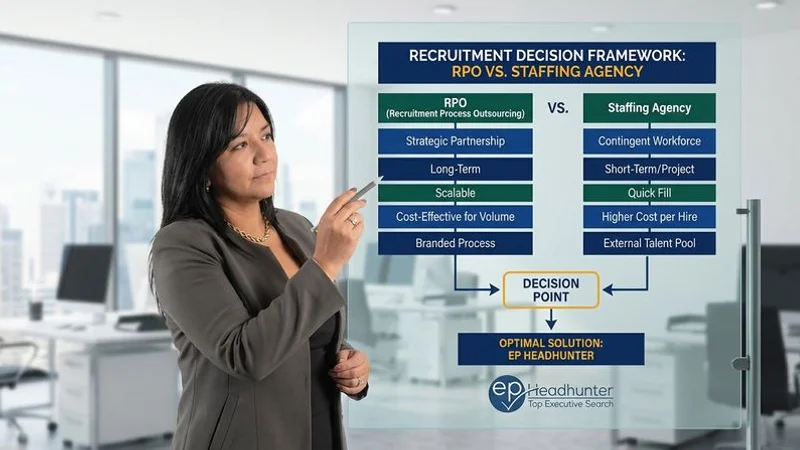
We’ve seen a significant shift in the Colombian labor market this year, particularly with the statutory work week dropping to 42 hours as of July 2026. This change compels business owners to rethink efficiency, making the choice between staffing agencies and Recruitment Process Outsourcing (RPO) more than just a hiring decision—it’s an operational necessity. While both models help you acquire talent, they serve fundamentally different strategic goals. Our team often compares it to the difference between calling a taxi and buying a fleet of vehicles; one solves an immediate, short-term need, while the other builds a long-term infrastructure.
Choosing the wrong model can lead to inflated costs and compliance risks, especially with the 2026 increase in Sunday and holiday surcharges to 90%. Understanding the nuance between these two approaches is essential for any company operating in Colombia or the broader Latin American region today.
How Staffing Agencies Work
A staffing agency operates on a transactional model, acting as a rapid-response solution for specific vacancies. We find that organizations typically engage these agencies to source, screen, and present candidates for a single open role. The agency receives a fee—usually a percentage of the hired candidate’s annual salary—only when a placement is successful.
Key characteristics of the staffing agency model:
- Transactional engagement: You hire for the role, not the process. Once the candidate accepts the offer, the agency’s work typically ends.
- Contingency-based fees: Most agencies in Colombia charge between 15% and 25% of the candidate’s annual salary, payable only upon hiring.
- Speed over depth: The agency’s primary incentive is to fill the seat quickly to secure their commission.
- External representation: Candidates often view themselves as applicants to the agency rather than directly to your company.
- Limited process control: You retain responsibility for interviewing, onboarding, and long-term retention strategies.
When staffing agencies are appropriate:
- You need to fill fewer than 10 positions annually.
- Your internal HR team handles the bulk of hiring but needs help with a niche role.
- You require a “stop-gap” solution for a sudden vacancy.
- The role is temporary or project-based, common in industries like construction or seasonal retail.
How RPO Works
Recruitment Process Outsourcing is a strategic partnership where a provider acts as an extension of your internal HR function. We approach RPO as a “lift and shift” of the recruitment responsibility, where the provider takes ownership of the entire lifecycle—from opening the requisition to onboarding the new hire. This model is governed by strict Service Level Agreements (SLAs) that track metrics like time-to-fill and quality-of-hire.
Key characteristics of the RPO model:
- Embedded integration: RPO recruiters often work under your email domain and brand. To a candidate, they appear to be members of your own talent acquisition team.
- Technology stack access: Providers bring their own licenses for premium tools like LinkedIn Recruiter, Computrabajo, or Applicant Tracking Systems (ATS) such as Taleo or Greenhouse.
- Fixed management fee: Instead of a high commission per hire, you typically pay a monthly management fee. This stabilizes cash flow and significantly lowers the cost-per-hire at high volumes.
- Scalability: The team size can flex up or down based on your hiring peaks, crucial for businesses with seasonal fluctuations.
- Data-driven insights: You receive regular reporting on market trends, salary benchmarks, and pipeline health.
Side-by-Side Comparison
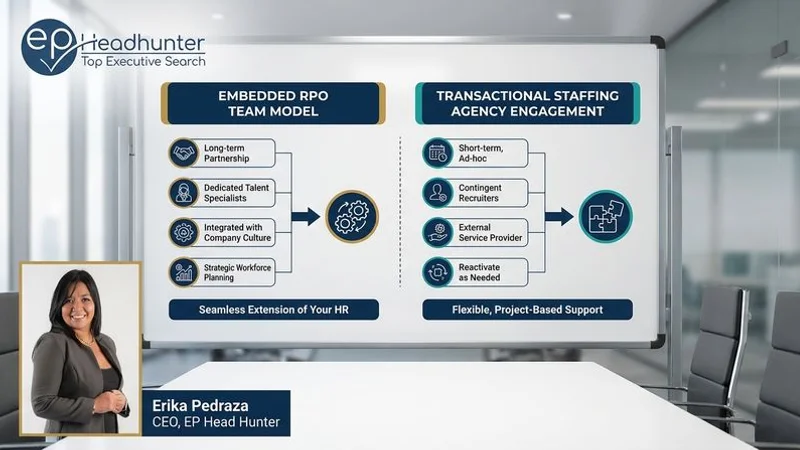
| Dimension | Staffing Agency | RPO |
|---|---|---|
| Engagement model | Transactional (per position) | Strategic partnership (ongoing) |
| Process ownership | Limited (sources and screens only) | Full (manages entire recruitment lifecycle) |
| Team integration | External (operates independently) | Embedded (works as part of internal team) |
| Pricing | Per-hire fee (15-25% of salary) | Management fee + optional transaction fees |
| Cost predictability | Variable (spikes with volume) | Predictable (fixed monthly structure) |
| Technology | Uses agency’s own closed systems | Implements/uses client systems with transparency |
| Employer brand | Represents themselves to candidates | Represents your employer brand |
| Reporting | Minimal (submission status only) | Comprehensive (pipeline analytics, market intel) |
| Scalability | Limited (add/remove agencies) | Built-in (team scales with demand) |
| Strategic value | Low (reactive execution) | High (process improvement, talent strategy) |
| Typical volume | 1-15 hires per year | 20-500+ hires per year |
| Contract duration | Per search (weeks to months) | Multi-year partnership (1-3 years typical) |
The Cost Comparison in Detail
The financial divergence between these models becomes stark when you analyze the data for a high-growth year. We have updated these figures to reflect the 2026 hiring landscape in Colombia.
Scenario: 50 hires per year at an average salary of COP 120,000,000 (Senior Professional)
Staffing agency model:
- Fee: 20% of annual salary per hire.
- Cost per hire: COP 24,000,000.
- Annual total: COP 1,200,000,000 (approximately USD 300,000).
- Result: High variable cost with zero investment in your own infrastructure.
RPO model:
- Management fee: COP 40,000,000 per month.
- Annual management fee: COP 480,000,000.
- Per-hire transaction fee (if applicable): COP 4,000,000 per hire.
- Annual transaction fees: COP 200,000,000.
- Annual total: COP 680,000,000 (approximately USD 170,000).
- Savings: COP 520,000,000 (approximately USD 130,000) — a 43% reduction.
This calculation does not even account for the indirect savings from reduced turnover. We consistently see that better-matched candidates, sourced through a rigorous RPO process, stay longer than those placed hastily by agencies racing to claim a commission.
The Hidden Costs of the Agency Model
Beyond the invoice, the staffing agency model carries hidden operational costs that many business owners overlook until it is too late.
- Hiring manager fatigue: Your internal managers must coordinate with multiple external recruiters, often reviewing duplicate resumes from different agencies.
- Inconsistent quality: Agencies often prioritize speed to beat competitors. This “race to submit” can lead to poorly screened candidates who lack cultural fit.
- Data black hole: You lose valuable market intelligence. Agencies keep the data on “silver medalist” candidates, meaning you have to pay to find them again for future roles.
- Vendor management overhead: Processing contracts and invoices for 5-15 different agencies requires significant administrative effort from your finance team.
Which Model Is Right for Your Organisation?
Choose a staffing agency if:
- You have a low volume of hires (fewer than 15 per year).
- Your needs are sporadic, such as replacing a single back-office role.
- You possess a strong internal recruitment function that only needs occasional support for niche roles.
- The positions are generalist roles widely available on public job boards like Computrabajo or El Empleo.
- You do not require deep analytics or process optimization.
Choose RPO if:
- You anticipate hiring 20 or more people consistently throughout the year.
- Your hiring needs are predictable, even if they fluctuate seasonally.
- Your internal HR team is overwhelmed or focused on employee relations rather than talent acquisition.
- You need to systematically improve quality and reduce the 50-60 day average time-to-fill for professional roles.
- You are expanding into new Colombian regions like Medellin or Barranquilla and lack local presence.
- You want to build a talent pipeline that belongs to you, not an external agency.
Consider a hybrid model if:
Some organizations find success by combining both approaches. We recommend using RPO for high-volume, recurring roles (like sales, customer support, or tech) while retaining a specialized executive search firm for C-suite appointments. This ensures operational efficiency for the bulk of your hiring while giving critical leadership roles the “white glove” attention they require.
RPO and Staffing Agencies in the Colombian Market
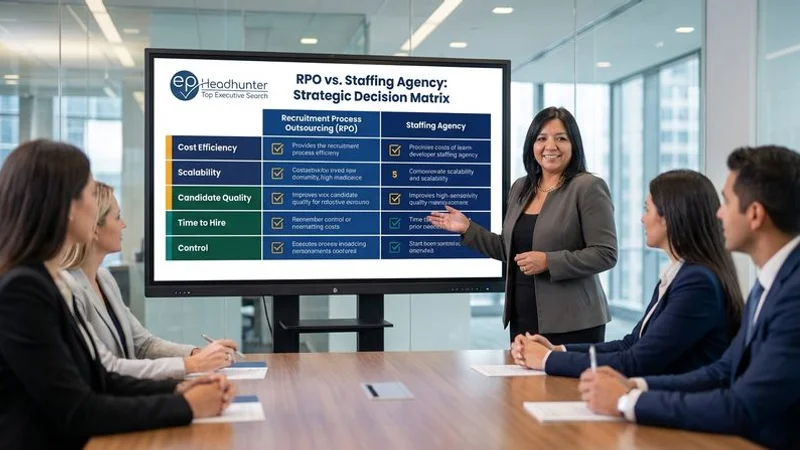
The Colombian talent market has unique characteristics that heavily influence this decision in 2026.
- Labor Reform Impact: The reduction of the work week to 42 hours (fully effective July 2026) requires precise workforce planning. RPO providers are better equipped to model these shifts than transactional agencies.
- Regional Nuance: Recruiting in Bogota is different from recruiting in Cali or Cartagena. We find that embedded RPO teams can better adapt your employer value proposition to these specific regional cultures.
- Compliance Complexity: Colombian labor laws regarding “Estabilidad Laboral Reforzada” (Reinforced Labor Stability) and the new 90% Sunday surcharge require strict adherence. RPO providers mitigate risk by ensuring every hire is compliant with the latest regulations.
- Technology Access: Top RPO providers in Colombia leverage advanced tools like Magneto or AI-driven sourcing platforms that are often too expensive for individual companies to license directly.
How EP HeadHunter Helps You Choose
EP HeadHunter offers both executive search and RPO solutions. We believe in recommending the model that fits your specific operational reality rather than fitting you into a rigid product. Our advisory process starts with a deep dive into your current hiring volumes, turnover rates, and growth projections for the next 12 to 24 months. From there, we design a talent acquisition strategy that delivers measurable ROI.
Uncertain whether RPO or a staffing agency is right for your organisation? Contact EP HeadHunter for a complimentary recruitment model assessment. We will analyze your current state and recommend the approach that best serves your talent acquisition objectives.