Why Measurement Is Critical for RPO Engagements
Deciding to implement Recruitment Process Outsourcing is a major strategic shift for any business.
We see organizations invest significant capital and political reliability to move from traditional models to an outsourced partnership.
But without rigorous measurement, you cannot determine if that investment is actually working.
Many companies launch these engagements with vague goals.
“Better hiring” is an aspiration.
“Reduced costs” is a wish.
Neither of these are metrics.
Our team has observed three specific problems arise when performance lacks precise definition:
- Accountability gaps: No one is held to a specific standard, so underperformance slides by unnoticed.
- Improvement stagnation: You cannot fix a process bottleneck if you don’t know it exists.
- Stakeholder confidence erosion: Executives lose faith in the model when they don’t see hard evidence of success.
This guide outlines the exact metrics business owners and HR directors need to track to ensure value.
The RPO Metrics Framework
Effective measurement covers four specific categories: efficiency, quality, cost, and experience.
We use these categories to build a complete picture of recruitment performance.
Category 1: Efficiency Metrics
Efficiency metrics tell you how quickly the engine is running.
Time-to-Fill
Definition: The number of calendar days from when a requisition is approved to when an offer is accepted.
Why it matters: A slow process costs you money.
Open roles mean lost revenue, burned-out staff, and candidates lost to faster competitors.
Benchmarks:
| Role Level | Target Time-to-Fill (Colombia) |
|---|---|
| Entry-level / Administrative | 20-30 days |
| Professional / Mid-level | 30-45 days |
| Senior Management | 45-60 days |
| Executive / C-suite | 60-90 days |
Measurement considerations: You must segment this data by role and location.
An aggregate number hides the truth.
We also recommend distinguishing between “RPO-controllable time” (sourcing) and “client-controllable time” (interviewing).
Pro Tip: In Colombia, background checks (referencing databases like Procuraduría or Contraloría) can add 3-5 days to the process. Factor this mandatory step into your targets to avoid unrealistic expectations.
Time-to-Present
Definition: The days elapsed from requisition approval to the presentation of the first qualified shortlist.
Why it matters: This metric isolates the provider’s speed from your internal decision-making.
It serves as a pure measure of sourcing efficiency.
Target: 7-14 days for professional roles; 14-21 days for senior and executive roles.
Requisition Ageing
Definition: The number of open requisitions that have exceeded their target time-to-fill.
Why it matters: This acts as an early warning system.
High ageing indicates a systemic problem in the pipeline or a misalignment on salary expectations.

Category 2: Quality Metrics
Speed means nothing if the new hire quits in three months.
We track these metrics to ensure the RPO produces employees who stay and succeed.
Quality of Hire
Definition: A composite score derived from performance and retention data.
Components of quality of hire:
- Hiring manager satisfaction: Survey managers 30 and 90 days after a hire. Ask about candidate relevance and process speed. Target: 4.0 or higher on a 5-point scale.
- New hire performance ratings: Look at the 6-month and 12-month reviews. Compare these scores against your company average.
- New hire retention rate: The percentage of hires who stay past the one-year mark. The industry benchmark sits around 85%.
- Time-to-productivity: Measure how weeks it takes for a new hire to function independently.
Shortlist Quality
Definition: The ratio of candidates presented versus those who get an interview.
Why it matters: A low ratio means the recruiters do not understand the role.
We consider it a red flag if managers reject resumes before meeting the candidate.
Target: At least 60-70% of presented candidates should move to the interview stage.
Offer Acceptance Rate
Definition: The percentage of extended offers that result in a hire.
Target: 85-90% acceptance rate.
If this number drops, you likely have issues with compensation competitiveness or your employer brand reputation in the local market.
Category 3: Cost Metrics
You need to know if the RPO is delivering financial value compared to your previous model.
Cost Per Hire
Definition: Total recruitment costs divided by the number of hires.
This includes management fees, technology costs, and ad spend.
Benchmarks:
| Role Level | Target Cost Per Hire (Colombia) |
|---|---|
| Entry-level | COP 3,000,000 - 5,000,000 |
| Professional | COP 5,000,000 - 10,000,000 |
| Senior Management | COP 15,000,000 - 25,000,000 |
| Executive | COP 30,000,000 - 60,000,000 |
Important: Ensure you compare apples to apples.
Your previous “internal” costs likely included hidden expenses like agency premiums, LinkedIn licenses, and the time your internal HR team spent screening resumes.
Total Recruitment Spend
Definition: The total annual expenditure on all talent acquisition activities.
Why it matters: RPO should optimize spend.
If you pay RPO fees but still rely heavily on external executive search firms for difficult roles, the scope is wrong.
Cost Avoidance
Definition: Savings generated by filling roles through the RPO rather than expensive contingency agencies.
How to calculate: (Number of RPO hires × Average agency fee) − (Actual RPO cost) = Cost avoidance.
Category 4: Experience Metrics
Recruitment is a reputation game.
We measure experience to protect your employer brand.
Candidate Experience Score
Definition: A survey sent to all interviewed candidates.
Survey dimensions:
- Clarity of communication.
- Speed of feedback.
- Professionalism.
- Accuracy of role description.
Why it matters: Candidates talk.
In Colombia’s tight professional networks, a bad interview process spreads quickly on social media or WhatsApp groups.
Hiring Manager Satisfaction
Definition: A survey for managers after a requisition closes.
Survey dimensions:
- Did the recruiter understand the technical requirements?
- Was the shortlist relevant?
- Was the process fast enough?
Target: A minimum score of 4.0 out of 5.

Building an RPO Scorecard
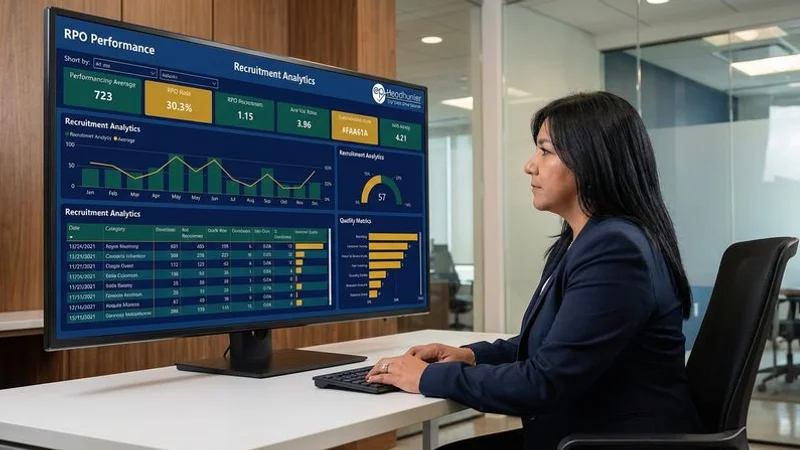
Data is useless if it sits in a spreadsheet no one reads.
We recommend consolidating these metrics into a monthly scorecard for joint review.
Sample RPO Scorecard Structure
| Metric | Target | This Month | Last Month | Trend |
|---|---|---|---|---|
| Time-to-fill (professional) | 35 days | 32 days | 38 days | Improving |
| Time-to-present | 10 days | 12 days | 14 days | Improving |
| Shortlist quality ratio | 65% | 72% | 60% | Improving |
| Offer acceptance rate | 88% | 85% | 82% | Improving |
| Cost per hire (professional) | COP 7M | COP 6.8M | COP 7.2M | Improving |
| Hiring manager satisfaction | 4.0/5 | 4.2/5 | 3.9/5 | Improving |
| Candidate experience score | 4.0/5 | 3.8/5 | 3.7/5 | Stable |
| 12-month retention rate | 85% | 88% | 86% | Stable |
Scorecard Review Cadence
- Weekly: Check pipeline status and immediate blockers.
- Monthly: Analyze trends and discuss process improvements.
- Quarterly: Review costs and service level agreements (SLAs).
- Annually: Conduct a full ROI analysis and contract assessment.
Common Measurement Mistakes
- Measuring only the easy stuff: Time-to-fill is simple to track. Quality of hire takes work but offers far more value.
- Blaming the provider for everything: You play a role too. If hiring managers take two weeks to give feedback, time-to-fill will suffer regardless of the RPO’s effort.
- Ignoring the baseline: You cannot prove improvement if you don’t know where you started.
- Focusing only on cost: Cheaper isn’t always better. Low-cost recruitment often leads to high turnover.
- Infrequent review: Looking at data once a year is a history lesson. Monthly reviews drive action.
How EP HeadHunter Approaches RPO Measurement
We operate on the principle that what gets measured gets improved.
Every engagement begins by establishing clear KPIs that align with your specific business goals.
Our team provides monthly scorecards and full transparency into performance data.
The goal isn’t just to fill seats.
We aim to improve the quality and cost-effectiveness of your entire talent management function.
Ready to establish a data-driven RPO partnership? Contact EP HeadHunter to discuss how our RPO solutions deliver measurable, transparent, and continuously improving recruitment outcomes.