Based on the detailed research into the Colombian executive market for 2025 and 2026, here is the enriched and rewritten article.
Understanding the Two Approaches
Selecting the right recruitment method is often the single most significant factor in the success of a senior leadership appointment. For business owners and boards in Colombia, the choice between traditional recruiting and headhunting (executive search) dictates not just the timeline, but the quality of the final hire. Our team has observed that many companies use these terms interchangeably, yet they represent two completely distinct business functions.
Traditional recruiting is a reactive process that relies on the “active” market—professionals who are currently applying for jobs on platforms like El Empleo or LinkedIn. It works efficiently for standard roles where the talent supply is high. Headhunting, however, is a proactive, research-intensive discipline—often called executive search—where we identify and engage specific leaders who are not looking for work. This distinction is critical because the executive who can transform your business is likely already successful in another role, not browsing job boards.

Key Differences Between Headhunting and Traditional Recruiting
Candidate Pool Quality
The most practical difference for an employer is the segment of the market you can access.
- Traditional recruiting targets the 20-25% of the workforce actively seeking a new job. These candidates are often available immediately but may not represent the top tier of performance in their sector.
- Headhunting unlocks the “passive” market, which accounts for approximately 75% of senior professionals. We specifically target top performers who are currently employed and delivering results for your competitors.
Confidentiality in Close Markets
Business circles in cities like Bogotá, Medellín, and Cali are remarkably interconnected. A public job posting for a General Manager or CFO can trigger rumors that unsettle investors and alert competitors to internal gaps. Executive search firms operate under strict non-disclosure agreements, allowing you to interview candidates without the market knowing a change is imminent. This discretion is mandatory when replacing an incumbent who is still in the post.
Research Depth and Market Mapping
Traditional recruiters typically filter inbound CVs against a job description. In contrast, true executive search involves talent mapping—a systematic process of identifying every potential candidate in a specific sector or region. Our researchers analyze target companies to understand their organizational charts, ensuring that no viable leader is overlooked before a shortlist is presented.
Timeline and Investment: The 2025/2026 Reality
Understanding the real-world costs and schedules is vital for planning.
| Factor | Traditional Recruiting | Headhunting (Executive Search) |
|---|---|---|
| Primary Focus | Active Job Seekers | Passive, Employed Leaders |
| Typical Role Level | Operational / Mid-Management | C-Suite / Director / Specialized |
| Fee Structure | Contingency (15-20% of salary) | Retained (20-30% of annual income) |
| Payment Terms | 100% upon success | 1/3 Start, 1/3 Shortlist, 1/3 Hire |
| Average Time to Fill | 4-8 Weeks | 12-16 Weeks (90-120 Days) |
| Guarantee Period | 3-6 Months | 6-12 Months |
When Traditional Recruiting Works Well
You do not need a retained search firm for every vacancy. Traditional methods are often the smarter financial choice when:
- The salary is below the “Salario Integral” threshold. For roles paying under 15-18 million COP, the active talent pool is usually sufficient.
- Speed is the priority. If you need a functional manager in a seat within 30 days, traditional posting is faster.
- The skill set is standardized. Roles like Accounting Managers or Regional Sales Supervisors generally have a high volume of qualified applicants.
- Volume is required. If you are opening a new BPO center and need 50 supervisors, contingency recruiting is built for that scale.
When Headhunting Is the Superior Choice
Retained executive search is designed for scenarios where the cost of failure is unacceptable. We recommend this approach when:
- The role impacts strategic direction. C-suite positions (CEO, CFO, CTO) require leaders who can drive change, not just manage operations.
- You need “Salario Integral” talent. Executives in Colombia earning over 13 legal minimum wages (approx. 18.5 million COP in 2025) expect a high-touch, confidential courtship process.
- The talent is scarce. In sectors like Fintech or specialized Engineering, there might be fewer than 50 qualified people in the entire Andean region.
- Cross-border searches are necessary. If you need a Country Manager with experience in both Colombia and the US market, local job boards will not find them.
The Cost of Getting It Wrong
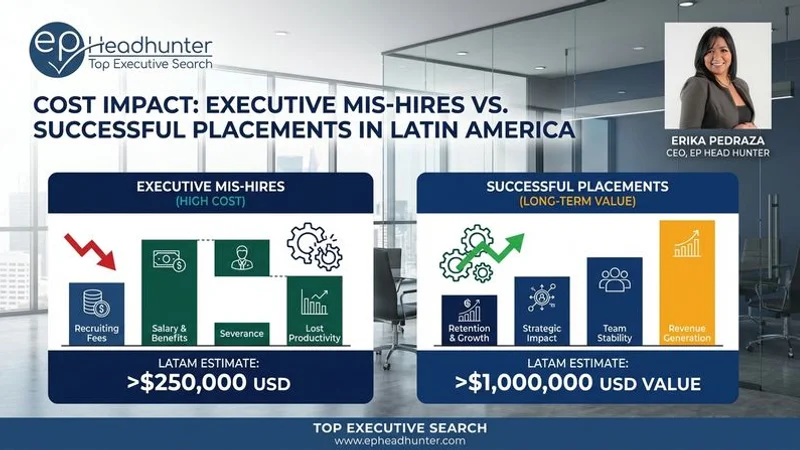
The financial impact of a bad executive hire in Colombia is often underestimated. Data from 2024 and 2025 suggests that replacing a failed executive costs between 100% and 200% of their annual package.
This figure includes obvious costs like the “Indemnización” (severance for termination without cause) and recruitment fees, but the hidden costs are worse. A mismatched leader causes strategic paralysis, loss of team productivity, and reputational damage that can take years to repair.
The Hybrid Reality
Smart organizations often utilize a tiered strategy. They employ internal HR teams or contingency agencies for the majority of their hiring volume while partnering with a specialized search firm for their top 5-10 critical roles each year. This approach balances budget efficiency with the need for premium talent at the top.
Making the Right Choice: A Decision Framework
Before launching your next search, ask these five questions to determine the right path:
- What is the strategic value? If this person makes decisions that affect the whole company, use executive search.
- Is the talent hard to find? If the profile is “purple squirrel” (extremely rare), a passive search is required.
- Is confidentiality non-negotiable? If yes, you cannot use traditional recruiting.
- What is the salary level? Roles offering a Salario Integral (18M+ COP) typically demand a retained approach.
- Do you have the internal bandwidth? Vetting executive candidates requires hours of deep-dive interviewing that most HR teams cannot spare.
The EP HeadHunter Perspective
At EP HeadHunter, we see ourselves as strategic partners rather than just recruiters. Our specific focus on the Colombian and Latin American markets allows us to understand the cultural nuances that make a leader successful here.
We employ a rigorous methodology that goes beyond the CV to assess leadership style and strategic fit. This ensures that the candidates we present are not just qualified on paper but are ready to lead your organization through its next phase of growth.
Ready to discuss your next executive hire? Contact EP HeadHunter to explore how our tailored search methodology can transform your leadership recruitment outcomes.