Why Executive Onboarding Demands a Different Approach
When organisations invest months in identifying, evaluating, and securing an executive hire, it is remarkable how often the onboarding process is left to chance. A standard orientation programme designed for mid-level employees is wholly inadequate for a C-suite or VP-level leader who must navigate complex stakeholder landscapes, absorb organisational culture, and deliver visible results within a compressed timeframe.
Research from the Harvard Business Review indicates that 40% of newly hired executives fail within their first 18 months. The primary causes are not competence gaps but integration failures: misaligned expectations, insufficient stakeholder relationships, cultural misunderstanding, and the absence of a structured talent management transition plan.
In the Colombian and Latin American business context, where relationships and trust are foundational to leadership effectiveness, the stakes of poor executive onboarding are even higher. A new leader who fails to build relational capital in the first 90 days will struggle to mobilise teams, influence peers, and earn the confidence of the board — regardless of their technical credentials.
We have seen firsthand how expensive these failures can be for local companies. Recent data suggests that replacing a failed executive search hire can cost an organisation up to 213% of the individual’s annual salary. For a CEO earning an average of 292 million COP annually, a single mis-hire could bleed over 600 million COP from your budget when you factor in recruitment fees, severance, and lost productivity. That figure does not even account for the strategic paralysis that occurs while the position sits vacant again.
The Three Phases of Executive Onboarding
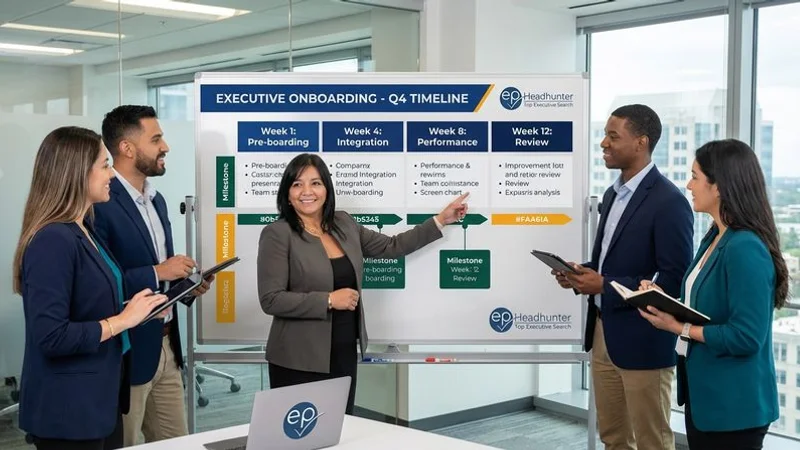
A well-designed executive onboarding programme spans the full first 90 days and is organised into three distinct phases, each with its own objectives, activities, and success metrics.
Phase 1: Orientation and Immersion (Days 1-30)
The first month is about listening, learning, and relationship-building rather than making sweeping changes. Executives who arrive with a transformation agenda on day one often alienate the very people they need to succeed.
Key activities during Phase 1:
-
Stakeholder mapping and introductions: Schedule one-on-one meetings with every member of the leadership team, key board members, and critical direct reports. In Latin American organisations, invest time in informal settings — lunches, coffees, and social events — where trust is built more naturally than in structured meetings. For high-level networking in Bogotá, venues like Club El Nogal or the Gun Club offer the privacy and prestige required for these sensitive initial conversations.
-
Organisational listening tour: Meet with employees at multiple levels and functions. Ask open-ended questions about what is working, what is not, and what the organisation needs from its new leader. Document themes rather than jumping to conclusions.
-
Cultural immersion: Understand the unwritten rules, decision-making norms, and relational dynamics. In Colombian organisations, hierarchy, formality, and indirect communication patterns may differ significantly from what the executive has experienced in other markets.
-
Strategic context review: Study the strategic plan, financial performance, competitive landscape, and regulatory environment. Understand not just what the numbers say but the narrative behind them.
-
Expectations alignment: Have explicit conversations with the CEO (or board chair, for the CEO) about what success looks like at 90 days, six months, and one year. Document these expectations and revisit them regularly.

Phase 2: Assessment and Strategy Formation (Days 31-60)
The second month is when the executive begins to form a point of view. They have listened enough to understand the landscape and can now start identifying priorities, opportunities, and risks.
Key activities during Phase 2:
- Diagnostic assessment: Evaluate the current state of the executive’s function or division against strategic objectives. Identify capability gaps, process inefficiencies, and cultural barriers.
- Team evaluation: Assess the executive’s direct reports — their capabilities, motivations, and development needs. Determine whether the current team configuration can deliver on the strategic mandate.
- Quick win identification: Select two or three achievable improvements that demonstrate competence, build credibility, and create positive momentum. Quick wins should be visible, valuable, and achievable without requiring extensive organisational change.
- Relationship deepening: Move beyond introductory conversations to substantive discussions about shared challenges, strategic alignment, and collaboration opportunities with peer executives.
- Draft strategic priorities: Begin formulating a 12-month plan for the function or division, informed by the listening tour, diagnostic assessment, and stakeholder input.
Phase 3: Action and Early Impact (Days 61-90)
The third month is about demonstrating leadership, delivering early results, and establishing the executive’s operating rhythm.
Key activities during Phase 3:
-
Present strategic priorities: Share the executive’s emerging strategy with the CEO and leadership team. This is not a final plan but a directional statement that invites feedback and builds alignment.
-
Deliver quick wins: The improvements identified in Phase 2 should be implemented and their impact communicated. Even modest wins — a process improvement, a resolved conflict, a restarted initiative — signal that the new leader is making a difference.
-
Establish team cadence: Implement regular team meetings, reporting structures, and communication norms. The executive’s leadership style should be becoming clear to their team.
-
Board or governance engagement: For C-suite executives, present to the board or relevant committees. This is an opportunity to demonstrate strategic thinking, organisational understanding, and leadership presence.
-
Feedback integration: Solicit structured feedback from the CEO, peers, and direct reports. Use this feedback to adjust approach, priorities, and communication style.
Common Executive Onboarding Mistakes
Even well-intentioned organisations make predictable errors during executive onboarding. Recognising these patterns helps avoid them.
| Mistake | Consequence | Prevention |
|---|---|---|
| No structured plan | Executive feels unsupported, wastes time on administration | Create a detailed 90-day plan before the executive’s start date |
| Expecting immediate results | Executive makes premature decisions without sufficient context | Set realistic Phase 1 expectations focused on learning |
| Isolating the executive | Leader builds relationships only within their direct function | Facilitate cross-functional introductions and informal social events |
| Skipping cultural orientation | Executive violates unwritten norms and loses credibility | Assign a cultural guide or mentor from the leadership team |
| Ignoring the predecessor’s legacy | Executive dismisses everything that came before, alienating loyal staff | Acknowledge what has worked while introducing new perspectives |
The Role of the Hiring Organisation
Executive onboarding is not solely the new leader’s responsibility. The hiring organisation must create the conditions for successful integration.
CEO Responsibilities
- Personally introduce the new executive to key stakeholders
- Schedule regular check-in meetings during the first 90 days
- Provide candid feedback on early impressions and potential blind spots
- Shield the executive from unrealistic early demands from the board or other executives
HR and Talent Team Responsibilities
- Design and manage the structured onboarding plan
- Coordinate stakeholder meetings and listening tour logistics
- Provide cultural briefings and organisational context documents
- Monitor integration progress and flag early warning signs
Peer Executive Responsibilities
- Invest time in building a genuine relationship with the new colleague
- Share honest perspectives on organisational dynamics and unwritten rules
- Offer collaboration opportunities that demonstrate trust and inclusion
- Avoid political games that undermine the new executive’s credibility
Measuring Onboarding Success
Effective onboarding programmes include measurable outcomes at each phase.
At 30 days:
- The executive can articulate the organisation’s strategy, culture, and key challenges
- Introductory meetings with all critical stakeholders are complete
- The executive reports feeling supported and informed
At 60 days:
- A diagnostic assessment of the executive’s function is complete
- Quick wins have been identified and are in progress
- The executive has formed initial strategic priorities
At 90 days:
- Strategic priorities have been presented and discussed
- At least one quick win has been delivered and communicated
- Stakeholder feedback indicates positive integration progress
- The executive has established their leadership rhythm and team cadence
Special Considerations for the Colombian Market
Executive onboarding in Colombia requires particular attention to several cultural factors:
- Relational investment: Trust is built personally, not institutionally. New executives must invest significant time in face-to-face relationship-building, often outside formal business settings.
- Family enterprise dynamics: In family-owned businesses — which represent a significant portion of the Colombian corporate landscape — understanding family governance, generational perspectives, and informal power structures is essential.
- Regional diversity: Colombia’s regional differences in business culture (Bogota, Medellin, Cali, Barranquilla) can significantly affect leadership style expectations. An executive accustomed to one regional culture may need deliberate coaching for another.
- Regulatory complexity: Colombia’s labour, tax, and regulatory environment is complex and evolving. New executives, particularly those arriving from outside the country, need thorough regulatory orientation.
How EP HeadHunter Supports Executive Onboarding
At EP HeadHunter, our commitment to successful placements extends well beyond the offer letter. We provide structured onboarding support that includes pre-arrival briefings, stakeholder alignment sessions, and periodic check-ins throughout the first 90 days. Our deep knowledge of the Colombian and Latin American executive landscape means we can anticipate integration challenges, advise on cultural navigation, and ensure that both the executive and the organisation are positioned for long-term success.
Preparing to onboard a senior executive? Contact EP HeadHunter to learn how our post-placement support can maximise the return on your executive hiring investment.