What Is DISC and Why Does It Matter for Executive Hiring?
You know the sinking feeling of hiring a leader who looked perfect on paper but destroyed team morale within months. It happens more often than most business owners admit.
We see this disconnect constantly in the Colombian executive market. A candidate ticks every technical box on their CV but fails completely when it comes to cultural fit and communication style.
This is where data has to replace gut feeling.
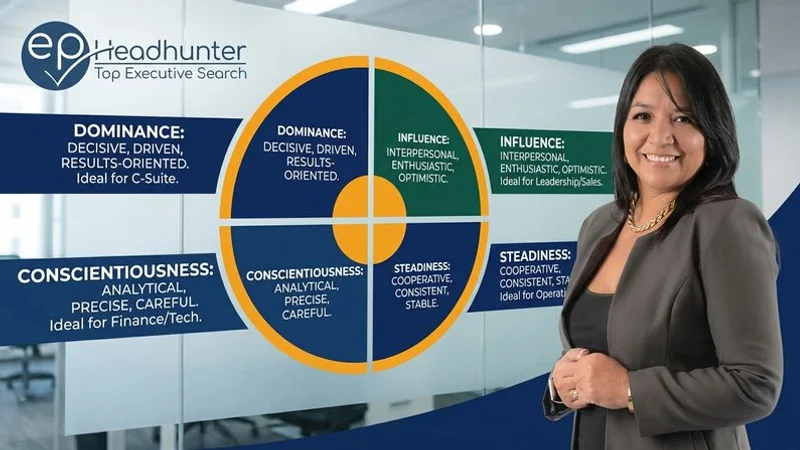
DISC is a behavioural assessment framework that categorises individuals along four primary dimensions: Dominance, Influence, Steadiness, and Conscientiousness. Based on the 1928 work Emotions of Normal People by William Moulton Marston, it has evolved into a staple for over 75% of Fortune 500 companies.
Our team uses this tool because it provides something interviews miss. It offers an objective, evidence-based understanding of how a candidate naturally behaves, communicates, and leads.
Technical competence is merely the entry ticket at the C-level. The true differentiator is leadership style and how it meshes with your existing ecosystem.
The Four DISC Dimensions
D — Dominance
Individuals with high Dominance are results-oriented, decisive, and direct. They thrive on challenge, value autonomy, and are comfortable making difficult decisions quickly.
In an executive context:
- Strong at setting direction and driving accountability.
- May struggle with patience, consultation, and delegation.
- Excel in turnaround situations and fast-paced environments like Bogotá’s high-growth tech sector.
- Risk factor: can alienate teams through an overly directive approach.
I — Influence
High-Influence individuals are enthusiastic, collaborative, and persuasive. They build relationships naturally, communicate effectively, and energise those around them.
In an executive context:
- Excellent at stakeholder management, fundraising, and external representation.
- May struggle with detail, follow-through, and confrontation.
- Excel in commercial roles or BPO (Business Process Outsourcing) environments where team morale is currency.
- Risk factor: may prioritise consensus over tough decisions.
S — Steadiness
Individuals with high Steadiness are dependable, patient, and team-oriented. They value stability, support others, and prefer structured, predictable environments.
In an executive context:
- Strong at building cohesive teams and sustaining operational excellence.
- May struggle with rapid change, ambiguity, and aggressive timelines.
- Excel in mature organisations and family-owned conglomerates (Pymes) requiring consistency.
- Risk factor: may resist necessary disruption or transformation.
C — Conscientiousness
High-Conscientiousness individuals are analytical, detail-oriented, and quality-focused. They value accuracy, process, and evidence-based decision-making.
In an executive context:
- Strong at risk management, compliance (crucial for legal or DIAN-facing roles), and complex problem-solving.
- May struggle with speed, ambiguity, and interpersonal dynamics.
- Excel in regulated industries and roles requiring precision.
- Risk factor: may over-analyse and delay decisions.
How DISC Enhances Executive Selection
1. Matching Leadership Style to Organisational Needs
Every organisation at every stage of its lifecycle requires a different leadership style. We find that a mismatch here is the number one reason for executive turnover in the first 12 months.
DISC helps match the candidate’s natural behavioural tendencies to the organisation’s current needs:
| Organisational Situation | Ideal Primary DISC Profile |
|---|---|
| Turnaround / crisis recovery | High D (Dominance) |
| Growth / market expansion | High D-I (Dominance-Influence) |
| Cultural transformation | High I-S (Influence-Steadiness) |
| Operational stabilisation | High S-C (Steadiness-Conscientiousness) |
| Regulatory compliance overhaul | High C (Conscientiousness) |
| Innovation / disruption | High D-I (Dominance-Influence) |
This matching is not about finding the “best” profile. It is about finding the right profile for the specific context.
A high-D CEO who excels in a turnaround may fail in an organisation that needs patient, consensus-driven cultural change. Context is everything.
2. Predicting Team Dynamics
Executive hires do not operate in isolation. They join an existing leadership team with its own established dynamics.
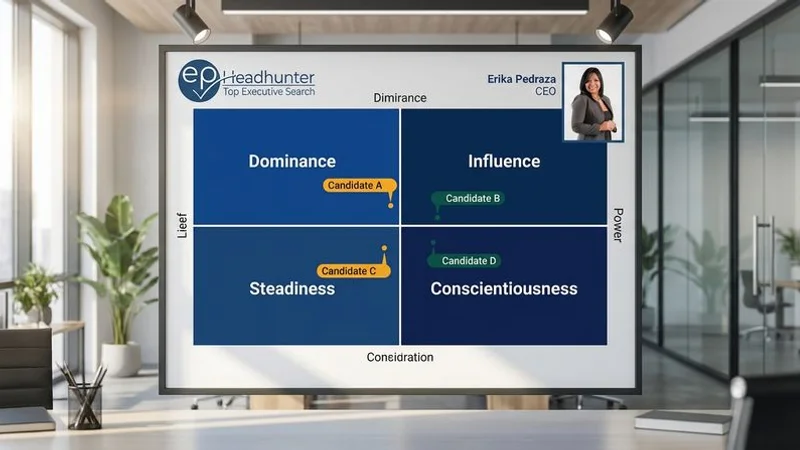
We use a “Team Wheel” approach to visualize where the new hire sits relative to the current board. DISC provides a framework for predicting how a new executive will interact with the existing team:
- Complementary profiles: a high-C CFO alongside a high-D CEO can create a productive balance of drive and rigour.
- Conflict-prone combinations: two high-D leaders in adjacent roles may generate productive tension or destructive competition.
- Cultural fit: an existing team dominated by high-S profiles may struggle to integrate a highly directive new leader.
By mapping the DISC profiles of the existing leadership team, organisations can make informed decisions about what behavioural attributes will enhance or disrupt team performance.
3. Informing Interview Design
DISC results should inform the interview process, not replace it. We recommend using the assessment results to structure “Behavioral Event Interviews” (BEI).
Knowing a candidate’s DISC profile allows interviewers to:
- Probe specific areas: if a candidate scores high-D, explore how they handle situations requiring patience and consultation.
- Test adaptability: ask candidates to describe situations where they operated outside their natural style.
- Assess self-awareness: discuss the DISC results with the candidate and evaluate how accurately they understand their own tendencies.
- Design role-plays: create scenarios that test the behavioural competencies most critical for the role.
4. Supporting Onboarding and Integration
DISC is not merely a selection tool. It is equally valuable during onboarding.
Data from the Harvard Business Review suggests that nearly 40% of new executive hires fail within 18 months. Often, this is due to poor integration, not lack of skill. Sharing a new executive’s DISC profile (with their consent) with their direct reports and peers accelerates mutual understanding.
Practical onboarding applications:
- Advise the new executive on how to adapt their communication style for different team members.
- Brief the existing team on the new leader’s preferences and working style.
- Identify potential friction points and create strategies to mitigate them.
- Establish coaching objectives based on the DISC profile’s development areas.
Limitations and Responsible Use
DISC is a powerful tool, but it must be used responsibly in the executive hiring context.
We always remind clients that this assessment is just one piece of the puzzle. It is a lagging indicator of behavior, not a predictor of future performance.
What DISC Does Not Measure
- Intelligence or cognitive ability — DISC measures behaviour, not intellect.
- Technical competence — it cannot assess industry knowledge or functional expertise.
- Values or integrity — behavioural style is separate from ethical disposition.
- Experience or track record — past performance is not captured by DISC.
Best Practices for Responsible Use
- Never use DISC as a standalone selection tool — it should be one data point among many.
- Avoid stereotyping — individuals are complex; DISC captures tendencies, not fixed traits.
- Use validated instruments — ensure the DISC tool used meets psychometric standards for reliability and validity, such as those from TTI Success Insights or Thomas International.
- Provide feedback — candidates should receive their results and an opportunity to discuss them.
- Consider cultural context — behavioural norms differ across cultures; what appears as “high Dominance” in a Colombian context may present differently in a Scandinavian one.

DISC in the Colombian and Latin American Context
Behavioural assessment in Latin American markets requires cultural sensitivity.
We operate in a region where cultural nuances significantly skew standard assessment baselines. Business culture in Colombia tends to value relationship-building (Influence) and respect for hierarchy (Steadiness).
Research using Hofstede’s cultural dimensions shows Colombia scores very low on Individualism (13) and high on Power Distance (67). This influences how DISC profiles present:
- High-I behaviours (warmth, expressiveness, relationship focus) are more normatively expected in Colombian business interactions than in, say, Northern European contexts.
- High-D directness may be perceived differently across Latin American cultures. What is valued as decisiveness in New York may be seen as “grosero” (rude) or abrasive in Medellín.
- Cultural masking — candidates may adapt their behaviour to cultural expectations, meaning their natural DISC profile may differ from their observed professional behaviour.
A skilled assessor understands these cultural nuances and interprets DISC results accordingly. We avoid the trap of applying universal behavioural norms to culturally specific contexts.
Integrating DISC into a Comprehensive Assessment
The most effective executive search processes use DISC as one element within a multi-method assessment battery.
Our methodology combines behavioral insights with hard data.
- DISC for behavioural style and communication preferences.
- Cognitive assessments for problem-solving and strategic thinking (measuring fluid intelligence).
- Personality inventories (e.g., Hogan) for deeper personality traits and risk factors.
- Competency-based interviews for evidence of past performance.
- Simulation exercises for observable behaviour under realistic conditions.
- Reference verification for third-party perspectives on the candidate’s track record.
This integrated approach produces a candidate profile that is significantly more predictive than any single assessment method.
How EP HeadHunter Uses DISC
At EP HeadHunter, DISC behavioural profiling is a standard component of our executive assessment methodology.
We use validated DISC instruments administered and interpreted by trained professionals. Our team integrates DISC findings with cognitive assessments, structured interviews, and simulation exercises to build a complete picture of each candidate.
Compliance is also a priority for us. We ensure all data handling adheres to Colombia’s Ley 1581 de 2012 regarding personal data protection. Our assessors are experienced in the Colombian and Latin American business context and interpret results with the cultural nuance this market demands.
Interested in incorporating DISC assessment into your executive hiring process? Contact EP HeadHunter to learn how our behavioural profiling methodology can enhance your leadership selection decisions.