
[AddInfographic]
The Rise of Cross-Border Executive Mobility in Latin America
Latin America is experiencing an unprecedented period of cross-border executive mobility. Multinational organizations expanding across the region, Colombian companies internationalizing into neighboring markets, and the post-pandemic normalization of remote leadership arrangements have created a complex and dynamic cross-border hiring environment.
For HR directors and boards, hiring an executive from another Latin American country through executive search introduces a layer of legal, tax, cultural, and logistical complexity that domestic hiring does not require. The consequences of getting it wrong range from contractual disputes and tax penalties to failed executive integrations and reputational damage.
Our team has seen firsthand how these challenges can derail even the most promising appointments. This guide provides a practical framework for navigating cross-border executive hiring across Latin America, with specific attention to the countries most relevant to Colombian organizations.
The Legal Landscape: Key Compliance Considerations
Employment Contracts Across Jurisdictions
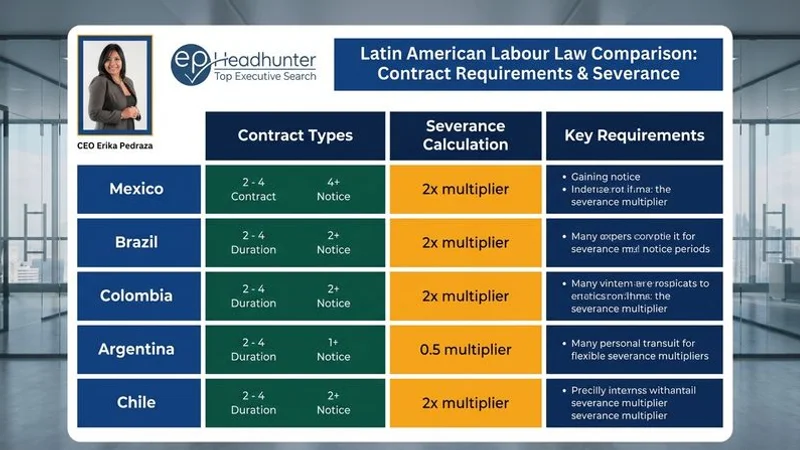
Each Latin American country has its own labor code, and the differences are consequential for executive hiring. We often see companies make the mistake of using a “standard” regional contract, which is legally dangerous.
Critical contract considerations by country (2025/2026 Data):
| Country | Probationary Period | Severance Structure | Non-Compete Enforceability |
|---|---|---|---|
| Colombia | 2 months (standard) | Graduated by tenure (Law 50) + COP 0.5 salary/year | Limited enforceability; must be compensated |
| Mexico | 30-180 days (varies) | “Constitutional Indemnity” (3 months) + 20 days/year | Enforceable if reasonable in scope/time |
| Brazil | 90 days | 40% FGTS penalty + notice period | Generally unenforceable unless compensated |
| Chile | None (at-will for execs) | 30 days/year (capped at 11 years & 90 UF) | Enforceable up to 2 years if compensated |
| Peru | 3-12 months (varies) | 1.5 salaries per year of service | Limited enforceability |
| Argentina | 6-12 months (Law 27.742) | 1 month/year (or new “Cese Laboral” fund) | Enforceable if compensated and reasonable |
Key implications for cross-border hiring:
-
Contract drafting jurisdiction: The employment contract must comply with the law of the country where the executive will perform their work, not the country of the hiring entity’s headquarters. An executive based in Mexico must have a contract that complies with Mexican labor law, even if the parent company is Colombian.
-
Severance liability awareness: The variation in severance costs across Latin American countries is significant. In Chile, the cap at 11 years and 90 UF (Unidades de Fomento) provides predictability. Argentina’s new Law 27.742 allows for a “Fondo de Cese Laboral” (severance fund) alternative, but this requires specific collective bargaining agreements to be in place.
-
Non-compete limitations: The enforceability of non-compete clauses varies dramatically. An executive hired from a competitor in Brazil may not be practically bound by their existing non-compete, while the same situation in Mexico could present legal complications.
The 2025/2026 Compliance Shock: Colombia’s Labor Reform
If you are hiring executives in or from Colombia, you must be aware of Law 2466 of 2025. This reform has fundamentally shifted the cost structure for employers.
Key changes you need to model:
- Night Shift Surcharge: The “night shift” now legally begins at 7:00 PM, not 9:00 PM. Any executive or manager not strictly classified as “trust and confidence” (dirección, confianza y manejo) who works past 7:00 PM may trigger overtime liabilities if their contract is not structured correctly.
- Sunday Premiums: The surcharge for working on Sundays and holidays is rising annually. It hit 80% in July 2025 and will rise to 90% in July 2026.
- Fixed-Term Limits: You can no longer renew fixed-term contracts indefinitely; the absolute maximum is now four years before it must convert to an indefinite contract.
Work Permits and Immigration
Cross-border executive hiring almost always requires immigration authorization. The complexity and timeline vary significantly.
Work permit overview:
- Colombia: The V Visa (Visitor) or M Visa (Migrant) are the standard routes. Processing time is currently 4-8 weeks.
- Mexico: The Temporary Resident Card for work purposes requires employer application through the National Immigration Institute (INM). Processing time is 6-12 weeks.
- Brazil: The VITEM V work visa requires employer sponsorship and Ministry of Labor approval. Processing time is 8-16 weeks.
- Chile: The Subject to Contract visa is tied to the employer. Processing time is 4-8 weeks.
- Peru: The Worker Migrant Quality visa requires employer registration. Peru limits foreign workers to 20% of a company’s workforce, but management and specialist positions are often exempt from this cap via a specific waiver request.
Insider Tip: The Andean Migrant Statute
For movement between Colombia, Peru, Ecuador, and Bolivia, the “Estatuto Migratorio Andino” (Decision 878) is a game-changer. It allows citizens of these four nations to apply for a Temporary Residence (valid for two years) without requiring a visa stamp first. This can shave weeks off the onboarding process for regional executives moving within the Andean Community (CAN).
Strategic recommendations:
- Begin immigration processes immediately upon offer acceptance.
- Engage local immigration counsel in the destination country, not just the home country.
- Ensure the executive’s family members (spouse, dependents) are included in immigration planning.
- Maintain compliance with ongoing reporting obligations (residence renewals, change of status notifications).
Tax Implications of Cross-Border Executive Employment
Executive compensation across borders creates tax complexities that, if mismanaged, can result in double taxation, penalties, and reputational risk.
Key tax considerations:
-
Tax residency determination: Most Latin American countries determine tax residency based on physical presence. In Colombia, you become a tax resident if you spend 183 days in the country within any 365-day period (not just the calendar year).
-
Double taxation treaties: Colombia has double taxation agreements with Spain, Chile, Mexico, and others. Crucially, for Andean countries (Peru, Ecuador, Bolivia), Decision 578 applies. This supranational law determines that income is taxed only in the country where it is earned, effectively eliminating double taxation for executives moving within the bloc.
-
Equalisation programmes: For executives relocating from higher-tax to lower-tax jurisdictions, tax equalisation programmes ensure the executive is no worse off. These programmes are complex to administer but essential for executive acceptance of cross-border assignments.
-
Social security coordination: Social security contributions (pension, health) in Latin American countries are not always portable. An executive who has contributed to the Colombian pension system for 15 years and then relocates to Mexico may face gaps in social security coverage that require employer intervention.
Recommendation: Engage a specialised international tax adviser before finalising any cross-border executive compensation package. The cost of expert tax advice is trivial compared to the cost of compliance failures.
Cultural Navigation: The Overlooked Success Factor
Legal and tax compliance are necessary conditions for successful cross-border executive hiring, but they are not sufficient. The primary reason cross-border executive assignments fail is not contractual; it is cultural.
Cultural Dimensions That Affect Executive Success
Despite the common perception that “Latin America is culturally homogeneous,” the reality is that business cultures across the region differ substantially.
Key cultural variations:
-
Communication directness: Argentine and Chilean executives tend toward more direct communication styles. In contrast, Colombian and Mexican business culture often favours indirect communication and diplomatic phrasing. An executive accustomed to Argentine directness may be perceived as abrasive in a Bogota boardroom.
-
Decision-making speed: Brazilian organisations are often characterised by deliberative decision-making with extensive consultation. Chilean companies tend toward faster, more centralised decision processes.
-
Hierarchy and formality: Colombian and Peruvian business cultures tend to be more hierarchical and formal (“Usted” usage is common) than Argentine or Chilean cultures. An executive transitioning from a flat, informal Argentine company to a hierarchical Colombian enterprise must adjust their leadership style accordingly.
-
Work-life boundaries: Expectations regarding working hours vary. In Colombia, the “Sobremesa” (extended post-lunch conversation) is a critical relationship-building tool, whereas in Santiago or Sao Paulo, lunch might be quicker and more transactional.
-
Relationship-building pace: In all Latin American countries, business relationships are personal. However, the pace differs. Colombian business culture tends to involve longer “getting to know you” periods before substantive business discussions.
Cultural Integration Strategies
-
Pre-assignment cultural briefings: Provide comprehensive briefings on the destination country’s business culture before the executive arrives. Use experienced local leaders to deliver these briefings.
-
Cultural mentor or buddy: Assign a respected local executive to serve as an informal cultural guide during the first six months. This person can explain unwritten rules and provide candid feedback.
-
Family integration support: Executive relocation is a family decision. Provide support for the executive’s spouse and children, including school research and social introduction opportunities.
-
Regular cultural check-ins: During the first year, schedule periodic conversations between the executive and their supervisor specifically focused on cultural adaptation.

Structuring Cross-Border Executive Compensation
The Three Common Models
-
Local-plus model: The executive is employed on a local contract in the destination country, with additional benefits (housing allowance, education subsidies) that recognize the relocation burden. This is the most common model for permanent transfers.
-
Home-based model: The executive remains on their home country contract with adjustments for cost-of-living differences. This model is more common for temporary assignments of 1-3 years.
-
Global employment model: The executive is employed by a regional or global entity and assigned to a specific country. This model provides flexibility but introduces tax complexity.
Cost of Living Comparison (2025 Estimates)
When structuring the package, you cannot assume a 1:1 currency conversion covers lifestyle costs.
| City | Cost of Living Index (vs. Bogota) | Housing Cost Impact |
|---|---|---|
| Bogota | Baseline (100) | Baseline |
| Mexico City | +30% to +40% Higher | significantly higher rent for expat zones (Polanco, Condesa) |
| Santiago | +25% to +35% Higher | Higher utilities and grocery costs |
| Sao Paulo | +20% to +30% Higher | Higher security and transport costs |
| Buenos Aires | Varies wildly | Lower in USD terms, but high inflation requires monthly salary indexing |
Compensation Elements for Cross-Border Executives
- Base salary: Adjusted for destination country cost of living.
- Variable pay: Aligned with destination country or regional targets.
- Housing: 6-12 months of furnished accommodation or housing allowance.
- Education: International school fees for dependent children.
- Home leave: 2-4 annual return trips for the executive and family.
- Tax equalisation: Net-of-tax comparison to ensure no disadvantage.
- Relocation support: Moving expenses, temporary accommodation, destination services.
- Language training: If required for the destination country (e.g., Portuguese for Brazil).
- Repatriation assistance: Support for return at assignment end.
Common Cross-Border Hiring Mistakes
- Underestimating timeline: Cross-border executive hires typically take 2-4 months longer than domestic hires.
- Ignoring family needs: An executive who accepts a cross-border role but whose family is unhappy will not stay. Invest in family integration from the outset.
- Assuming legal similarity: “It’s Latin America, the laws are similar” is a dangerous assumption. Each country’s labor code is unique.
- Neglecting repatriation planning: For temporary assignments, failing to plan the executive’s return leads to high post-assignment attrition.
- Overlooking currency risk: Compensation denominated in a volatile local currency can erode the executive’s purchasing power. Consider currency protection mechanisms.
How EP HeadHunter Facilitates Cross-Border Executive Hiring
We understand that hiring across borders is about more than just finding a candidate; it’s about securing a successful transition. Our regional network across Colombia and Latin America enables us to manage cross-border executive searches with talent mapping capabilities, local knowledge, legal awareness, and cultural sensitivity that these complex engagements require.
We coordinate with local legal counsel, immigration specialists, and tax advisers in each destination country to ensure full compliance. Our talent management consulting services help organizations and incoming executives handle the details of cross-cultural leadership integration.
Planning a cross-border executive hire in Latin America? Contact EP HeadHunter to discuss how our regional expertise can ensure your international executive placement is compliant, culturally successful, and strategically effective.