The Most Important Decision a Board Will Make Selecting the next CEO is widely regarded as the single most consequential decision a board of directors will face. Yet, our team frequently receives urgent calls from organizations reacting to a sudden departure rather than executing a planned strategy. A 2024 report by the Taplow Group reveals a stark reality: only 29% of firms have a formal succession plan in place.
Effective CEO succession planning is not a crisis response — it is a continuous governance discipline that should begin years before the transition occurs.
Why Succession Planning Fails
Before examining best practices, it is worth understanding why succession planning so frequently goes wrong:
- Boards conflate succession planning with emergency replacement. Having a name in a sealed envelope is not a strategy; it is a disaster mitigation tactic.
- The incumbent CEO controls the process. This creates an inherent conflict of interest that often biases candidate selection toward a “clone” of the current leader.
- Internal candidates are not developed systematically. Potential successors are often identified but then left without the rotation or P&L exposure they need to be ready.
- External market knowledge is absent. Boards that only look inward risk missing superior talent; 2025 data shows external CEO appointments in the S&P 500 nearly doubled to 33%, signaling a shift toward fresh perspectives.
- The timeline is compressed. Rushed processes lead to mistakes, and the cost is high—replacing a highly skilled executive can cost up to 213% of their annual salary.
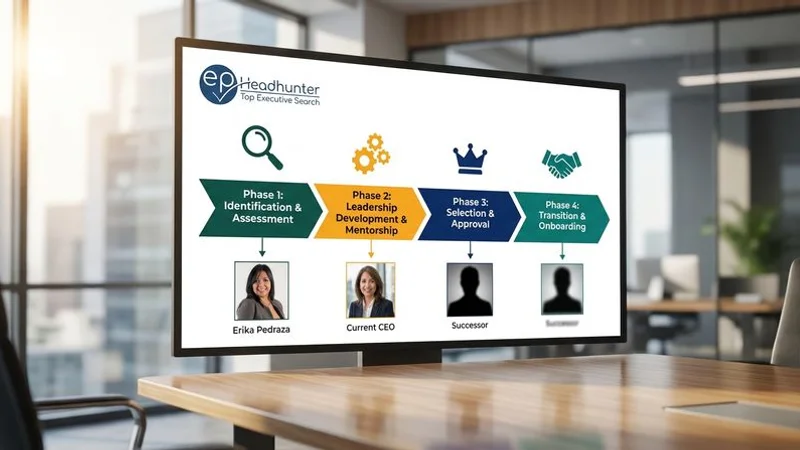
A Framework for Effective Succession Planning
Phase 1: Establish the Strategic Context (3-5 Years Before Transition)
The board must first define what the organization will need from its next CEO. This requires a forward-looking strategic assessment rather than a backward-looking appreciation of the current leader.
We advise boards to ask four specific questions:
- Where will the organization be in 5-10 years? Consider specifically the Colombian energy transition, digital banking shifts, or infrastructure developments.
- What leadership capabilities will be required? A CEO who led through a growth phase may not be the right leader for a period of consolidation or transformation.
- What is the organizational culture, and should it evolve? The next CEO will either reinforce or reshape the culture.
- What are the stakeholder expectations? Investors, employees, regulators, and customers may have different priorities for the next leader.
In the Colombian context, boards should also consider:
- Regulatory alignment: Adherence to the recommendations of Código País, which reached a historic implementation high of 63.13% in 2022.
- ESG leadership: The increasing importance of environmental and social governance in attracting international investment to the region.
- Cross-border complexity: Operational nuances for organizations expanding beyond Colombia into Peru, Ecuador, or Panama.
Phase 2: Assess the Internal Pipeline (2-4 Years Before Transition)
With the future leadership profile defined, the board can evaluate internal candidates against these criteria. Recent trends show a strong preference for internal hires to preserve culture, but they must be validated against the market.
Strategic Trade-offs: Internal vs. External Candidates
| Feature | Internal Candidate | External Candidate |
|---|---|---|
| Cultural Fit | High: Knows the DNA, unspoken rules, and politics. | Variable: Brings new norms that may clash or refresh. |
| Ramp-up Time | Fast: Productive almost immediately. | Slower: Typically needs 6-9 months to reach full productivity. |
| Strategic Change | Incremental: Likely to continue current trajectory. | Transformational: Easier to mandate radical shifts or cuts. |
| Retention Risk | Low: promoting signals internal mobility. | High: “Passed over” internal candidates often leave. |
The evaluation should be conducted with independence. Boards that rely solely on the incumbent CEO’s assessment of internal candidates risk inheriting the CEO’s biases and blind spots. External assessment — through psychometrics, structured interviews, and 360-degree feedback — provides a more objective picture.
Phase 3: Develop Internal Candidates (Ongoing)
Identifying potential successors is meaningless unless they receive the developmental experiences necessary to prepare them for the CEO role. These experiences should be deliberate and structured:
- Cross-functional rotations: Ensure candidates understand all major business functions, not just their silo.
- P&L responsibility: Give candidates accountability for revenue and profitability, perhaps in a smaller division or region.
- Board exposure: Allow candidates to present to the board, interact with non-executive directors, and understand governance expectations.
- The “COO” Pathway: Data from 2024 suggests 22% of companies are using the Chief Operating Officer role specifically as a transitional testing ground for future CEOs.
- Crisis management: Ensure candidates have navigated significant organizational challenges.
- International experience: This is particularly important for organizations operating across Latin America.
Phase 4: Monitor the External Market (Ongoing)
Even organizations with strong internal candidates should maintain awareness of the external talent market. This serves two purposes:
- Benchmarking: Understanding how internal candidates compare to the best available external talent.
- Optionality: Ensuring the board has alternatives if internal candidates do not develop as expected.
An executive search firm can provide ongoing market intelligence through a retained advisory relationship. We often deliver periodic “market maps” that track leadership movements, emerging talent, and compensation trends across the Andean region.

Phase 5: Make the Decision (12-18 Months Before Transition)
When the transition timeline becomes concrete — whether through planned retirement, contract expiration, or other circumstances — the board must move decisively:
- Convene the succession committee. This typically comprises the board chair, lead independent director, and governance committee members.
- Finalize the candidate assessment. Include any external candidates identified through search.
- Conduct final-round evaluations. Use in-depth interviews, psychometric reviews, and reference checks.
- Select the preferred candidate. Base this on evidence, not politics or personal relationships.
- Negotiate terms. This includes compensation, performance expectations, and transition support.
Phase 6: Execute the Transition (6-12 Months)
The transition period is critical and often poorly managed. Best practices include:
- Overlap period: The incoming CEO works alongside the outgoing CEO for 3-6 months.
- Stakeholder introductions: Systematic meetings with key investors, clients, regulators, and partners.
- 100-day plan: A structured agenda for the new CEO’s first hundred days.
- Board support: Regular check-ins between the board chair and new CEO during the first year.
- External coaching: Executive coaching to support the transition, particularly for first-time CEOs.
Common Pitfalls in Latin American Succession
Organizations in Colombia and the broader region face specific succession challenges that go beyond the global standard.
Key Regional Challenges:
- The “Family Trap”: According to Superintendencia de Sociedades, 70% of Colombian companies are family-owned, yet only 30% survive the transition to the second generation.
- Founder-led stagnation: Organizations often struggle to transition from a founder’s intuition to professional management structures.
- Political instability: Regulatory shifts can accelerate or delay transitions unpredictably, requiring agile leadership.
- Talent concentration: The talent pool is often clustered in major cities like Bogota, Medellin, and Cali, limiting geographic diversity.
- Cross-border complexity: Finding leaders who can navigate the regulatory, cultural, and operational differences across multiple Latin American countries is difficult.
The Role of an Executive Search Firm in Succession Planning
An executive search firm adds value at every phase of the succession process:
- Phase 1: Providing market intelligence on future leadership trends and requirements.
- Phase 2: Conducting independent assessments of internal candidates.
- Phase 3: Advising on developmental assignments and talent management strategies.
- Phase 4: Mapping the external market and maintaining a shortlist of external candidates.
- Phase 5: Managing the final evaluation and selection process with objectivity and rigor.
- Phase 6: Supporting the transition through onboarding advisory and executive coaching.
How EP HeadHunter Supports Board Succession Planning
EP HeadHunter partners with boards across Colombia and Latin America to design and execute CEO succession strategies that balance internal development with external market awareness. Our approach is evidence-based, confidential, and aligned with international governance standards. Whether your organization is three years or three months from a leadership transition, we provide the expertise and market intelligence to ensure the process delivers the right leader for the next chapter.
Is your board prepared for its next leadership transition? Contact EP HeadHunter to discuss a tailored succession planning engagement.