The Hidden Cost of Executive Mis-Hires
You know the feeling when a high-stakes decision doesn’t go according to plan.
It is particularly painful when that decision involves a senior leader.
We have seen firsthand that a mis-hire at the executive level is never just an inconvenience.
It represents a strategic anchor that drags down financial performance, operational momentum, and company culture.
Financial data reinforces this reality.
Studies from the Centre for American Progress estimate the cost of a failed senior hire at up to 213% of the employee’s annual salary.
This number is staggering when applied to the local market.
For a C-suite role in a major Colombian enterprise, where total annual compensation often exceeds COP 500 million, the losses can quickly escalate into the billions.
Direct expenses like recruiting fees and severance packages under Article 64 of the Substantive Labor Code are just the tip of the iceberg.
The indirect costs are often worse.
Disrupted client relationships, stalled projects, and the “contagion effect” on team morale can take years to repair.
We find that the traditional hiring process is simply not built to catch these risks.
CV reviews and standard panel interviews often fail to predict executive success.
Research consistently shows that unstructured interviews have a predictive validity of roughly 0.38.
That is barely better than flipping a coin to decide who will lead your company.
Assessment centres offer a more reliable path.
They ground the selection process in behavioural science rather than gut feeling.
This approach reveals how candidates act in reality, not just how they polish their stories in a conference room.
What Is an Executive Assessment Centre?
An assessment centre is not a place, but a process.
It is a structured evaluation method where candidates are observed across a series of exercises designed to mirror the actual challenges of the role.
We move beyond self-reported experience.
Standard interviews rely on what a candidate says they did.
Our assessment centres generate real-time evidence of what a candidate can do.
Key characteristics of this evaluation method:
- Multiple Assessors: Several observers evaluate each candidate to eliminate individual bias.
- Realistic Simulations: Exercises replicate specific business scenarios relevant to the Colombian market.
- Holistic Evaluation: We measure both cognitive processing and behavioural traits.
- Integrated Data: Results are combined into a detailed competency profile.
- Time Investment: The process typically spans one to two days to ensure depth.
Core Components of an Executive Assessment Centre
We build our assessment centres around five distinct components to ensure a complete picture of every candidate.
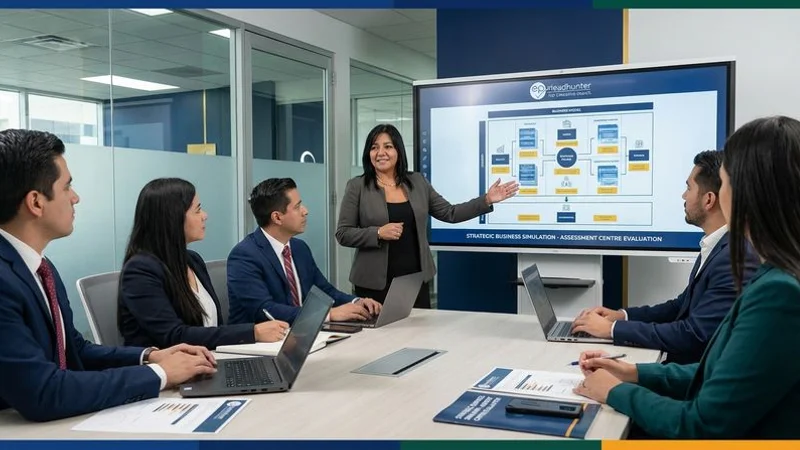
1. Strategic Business Simulations
Candidates step into a realistic business scenario that mirrors your company’s current landscape.
They might face a market entry challenge in the Andean region, a sudden PR crisis, or a complex restructuring requirement.
We ask them to analyze the situation, formulate a strategy, and defend their recommendations.
These simulations reveal critical traits:
- Strategic Agility: Can they pivot when new data arrives?
- Information Synthesis: How do they handle complex, incomplete data sets?
- Decision Quality: Do they crumble or clarify under time pressure?
- Persuasion: Can they communicate a vision that brings others along?
2. Role-Play Exercises
Executive leadership is fundamentally about interaction.
Candidates engage in one-on-one scenarios that simulate the most difficult conversations a leader faces.
We design these scripts to test specific soft skills.
- The Boardroom Defense: Presenting a controversial strategy to a skeptical board of directors.
- The Performance Correction: addressing a toxic high-performer or an underperforming direct report.
- The High-Stakes Negotiation: Managing a conflict with a major supplier or regulatory body like the DIAN.
- The Crisis Press Conference: Handling aggressive questions from the media regarding a corporate issue.
These moments strip away the rehearsed interview persona.
They expose emotional intelligence, composure, and the ability to read a room.
3. In-Tray / In-Basket Exercises
This is a test of executive bandwidth.
Candidates receive a simulated email inbox populated with reports, urgent complaints, conflicting requests, and calendar invites.
We watch how they process the noise.
Successful executives must distinguish between what is urgent and what is important.
The exercise measures:
- Prioritization Logic: Do they tackle the hardest task or the easiest one first?
- Delegation Skills: Do they know which tasks to pass to their team?
- Managerial Judgment: Can they spot the red flags hidden in routine correspondence?
4. Psychometric Assessments
Observational data is powerful, but we validate it with standardized science.
Psychometric tools provide an objective baseline that helps explain why a candidate behaves a certain way.
| Assessment Type | What It Measures | Common Tools |
|---|---|---|
| Cognitive ability | Problem-solving, critical thinking | Watson-Glaser, SHL Verify |
| Personality | Work style, preferences, risk factors | Hogan, OPQ, NEO PI-R |
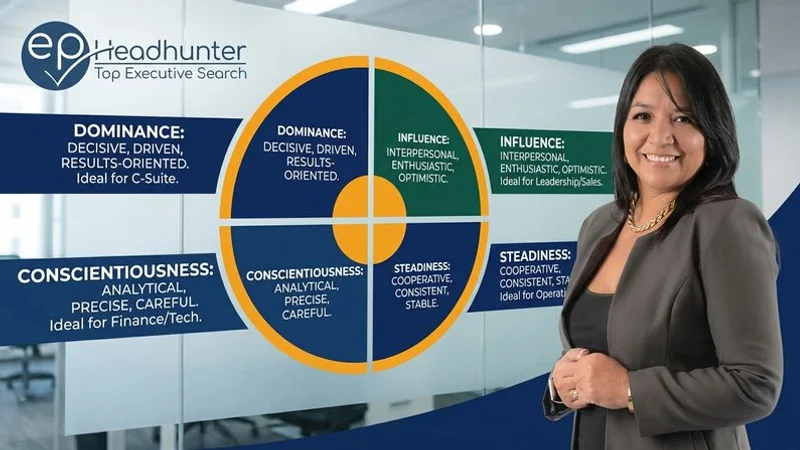
| Behavioural style | Communication, influence, team dynamics | DISC, Insights Discovery |
| Emotional intelligence | Self-awareness, empathy, regulation | EQ-i 2.0, MSCEIT |
| Leadership potential | Adaptability, learning agility | Korn Ferry viaEDGE |
5. Structured Competency Interviews
We replace the casual “get to know you” chat with a rigorous framework.
Structured interviews use consistent, behavioural questions linked directly to the competencies required for the role.
Every candidate faces the exact same questions.
Responses are evaluated against a standardized rating scale rather than the interviewer’s personal preference.
This methodology boosts predictive validity to 0.62.
It creates a fair comparison where the best candidate wins, not the best storyteller.
How Assessment Centres Reduce Hiring Risk
Evidence-Based Decision-Making
We move the final hiring decision from “I like them” to “The data supports them.”
Assessment centres generate thousands of data points on a single candidate.
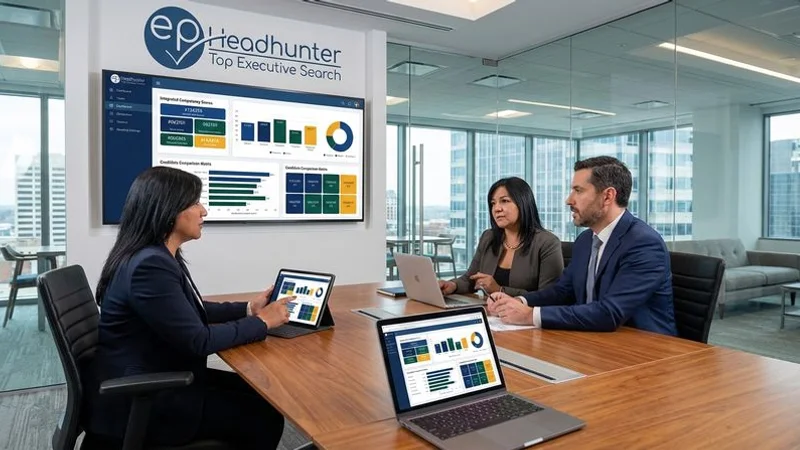
Selection committees can then review a multi-dimensional profile based on observed performance rather than a single interaction.
Each competency is rated independently.
This triangulation of data makes the final profile significantly more reliable than any solo interview could ever be.
Revealing Behaviours That Interviews Cannot
Candidates today are professionally coached to ace interviews.
They have prepared answers for their weaknesses, their greatest strengths, and their leadership philosophy.
We create environments where scripts fail.
A candidate cannot prepare for a surprise crisis simulation or an aggressive role-play they have never seen.
Authentic behaviour emerges under pressure:
- Does the candidate seek consensus or dictate orders?
- How do they respond to direct challenge and disagreement?
- Do they double down on mistakes or adapt their approach?
- How do they treat “subordinates” in the simulation versus the assessors?
Predicting Performance in Context
Generic leadership skills are rarely enough.
We design assessment centres to predict performance in your specific context.
A CFO leading a digital transformation needs different reflexes than a CFO managing a bankruptcy restructuring.
If your incoming CEO faces a hostile acquisition, the exercises must test stakeholder management and crisis leadership.
Context is everything.
This ensures we are not just evaluating “good leadership,” but the specific type of leadership your business demands right now.
Reducing Unconscious Bias
The “Halo Effect” often clouds judgment in traditional interviews.
This occurs when an interviewer lets one positive trait, like charisma or a shared university background, overshadow serious deficiencies.
We structure the assessment process to dismantle these biases.
Multiple assessors evaluate candidates across different exercises.
Research confirms that this method produces more diverse leadership outcomes because it focuses on execution rather than background or presentation.
Designing an Effective Executive Assessment Centre
A poorly designed assessment is just as dangerous as a bad interview.
We adhere to strict design principles to ensure the data is valid and actionable.
Our five pillars of effective design:
- Role-Specific Framework: We link every exercise to the specific competencies that predict success in that unique role.
- Calibrated Assessors: Observers are trained to spot behaviours and avoid common rating errors like the “contrast effect.”
- Data Triangulation: We assess every critical competency in at least two different exercises to verify findings.
- The Integration Session: Assessors must debate and reconcile their observations to reach a consensus rating.
- Candidate Respect: The process is challenging but fair, leaving candidates with a positive impression of your employer brand.
Assessment Centres in the Colombian Context
Hiring in Colombia presents unique challenges that standardized global processes often miss.
We find that assessment centres are particularly valuable here for several reasons.
Overcoming the “Rosca” Dynamic: In Latin America, personal networks and “palanca” (leverage) can often influence hiring. Simulations cut through these social connections to reveal actual merit and capability.
Addressing Cultural Communication: Colombian business culture is high-context and relationship-driven. Interviews can sometimes be overly polite or indirect. Assessment exercises force candidates to demonstrate how they handle direct conflict and tough decisions, which are often glossed over in polite conversation.
Compliance and Governance: Colombian corporate governance is tightening, influenced by OECD standards. Investors and boards now require documented, defensible evidence for C-level appointments. An assessment report provides the audit trail necessary to justify high-stakes hiring decisions.
The Return on Investment
The price tag often surprises first-time clients.
An executive assessment centre typically costs between COP 8 million and COP 25 million per candidate.
We view this not as an expense, but as an insurance policy.
Compare this fee to the cost of a mis-hire.
When you factor in a salary of COP 600 million, a 30% recruiter fee, severance costs, and lost revenue, a single failed executive can cost over COP 1 billion.
The ROI is measurable and immediate:
- Retention: Companies report a 40-60% reduction in executive turnover in the first 24 months.
- Performance: Assessed hires consistently achieve higher performance ratings in their first year.
- Diversity: Structured data reduces bias, leading to more diverse leadership teams.
- Confidence: Boards make offers with conviction, knowing the decision is backed by rigorous proof.
EP HeadHunter’s Assessment Centre Methodology
We integrate custom-built assessment centres directly into our executive search process.
Our team does not believe in off-the-shelf solutions for critical roles.
Every assessment is engineered around the specific challenges your future leader will face.
We use trained assessors with deep experience in the Colombian market to ensure cultural nuance is understood and respected.
Transparency is our standard.
Clients receive a full debrief, and candidates receive constructive feedback, regardless of the outcome.
Great hiring decisions are built on evidence.
Our methodology exists to deliver that evidence so you can lead with confidence.
Want to reduce the risk of your next executive hire? Contact EP HeadHunter to discuss how our assessment centre approach can strengthen your leadership selection process.